Monday, November 18, 2013

Energy! C'MON C'MON USE YOUR ENERGY BY CLICKING ON THIS!!!

Hello peoples of the universe! I’m back! This week we will be talking about energy. You know what energy is? I hope so, but if not you will learn all about it today! Energy is a really simple topic to learn about, and I’m glad to be the one teaching you!


When objects have energy, they have the capability to cause change. There are two types of energy that relate to motion, kinetic energy and potential energy. Potential energy is when energy that is stored increases or decreases due to the objects position or condition. So, for instance, use this as an example. Have you ever been bowling? Well, when you are holding the ball, about to throw it, you are building up potential energy. Then, once you throw it, the object is in motion, so it has kinetic energy.
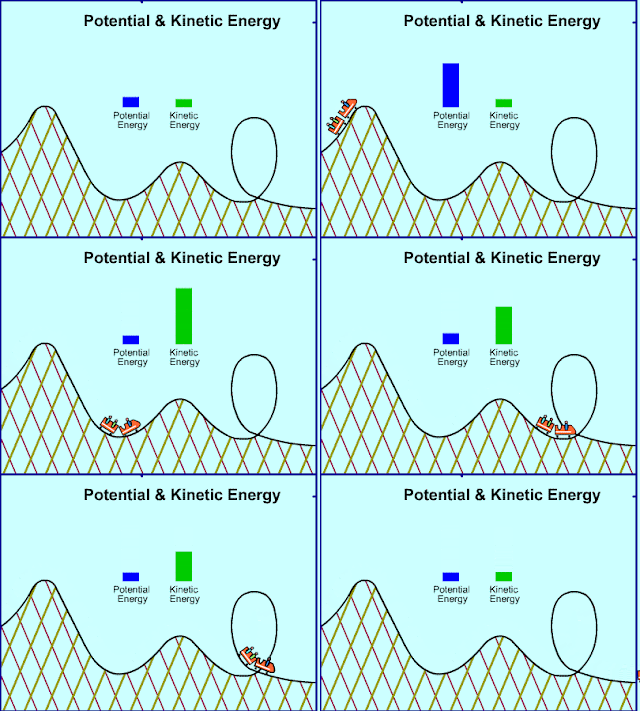

A/N - I know I didn't use a roller coaster for an example… but it shows the difference… so… yeah…

When an object is in motion, it has kinetic energy. You can only have kinetic energy if it’s in motion. The more mass and speed an object has, the more kinetic energy it has. Now for an example! A huge snowball (200 pounds) is going 30 miles per hour along with a person (120 pounds) running 15 miles per hour downhill (both are downhill). Which one has the most kinetic energy? The large snowball! It’s that because it has more mass and more speed. Now, when that person is about to start running and the snowball is about to fall, which one would have more potential energy? The snowball, one again! It’s that because the snowball has a larger mass than the person.


SNOWBALL!


Okay! A little more left, and you are done! Let's go back to the example about bowling. When you bowl, you throw a bowling ball in a lane and they hit pins. When the ball is rolling, it is building speed and more kinetic energy. When the ball hits the pins, it transfers its energy from the ball to the pins. These pins now fall down in a domino-like reaction and you (hopefully) get a strike! When this is happening, the energy transferred from one object to another by colliding. Cool, isn’t it? When two things are side by side on a shelf, one has more potential energy. Do you know which one? Well, these two items are a small thin book, while the other is a huge think book. The huge thick book will have more potential energy because of its size and weight.


Did you like my blog about random energy and how you are using it now
Please tell me your feedback! I'd like to know how I did!
 I would love to know what you thought of this! 
Thanks for reading everyone! <3

xoxo Teemster! :D

Sunday, November 10, 2013

Matter Changing States

            Hello People! Sorry I haven’t posted in a while; my schedule has been really crazy. Anyway, lets learn some more about science! I have a quiz on Thursday, and I need to study for it. While I am studying, you will be learning! Yay! :D


            We are going to learn about matter and what happens when it changes states. First, you will need to know some of the basics. Matter is anything that takes up space. Some examples being paper, carrot juice, and even carbon dioxide! I know, pretty random, but they are all made of matter. Paper, carrot juice, and carbon dioxide are examples of the three basic states of matter. The three basic states of matter are solids (paper), liquids (carrot juice), and gasses (carbon dioxide). All three states are completely different, but extremely similar at the same time. Confusing, I know, but you will get it in a second.


I’m going to use water (I know, everyone uses this, it’s just the easiest to understand) as an example. We are going to start with ice. Ice is a solid. A solid is a state of matter where the particles are bonded together in a lattice structure. If you were to give energy to it, like melting it, you would get water. Water is a liquid. A liquid is a state of matter that contains energy, but only enough for the particles to move around a little freely. If you were to take even MORE energy from water, like vaporization, you would get water vapor. Water vapor is a gas. A gas is a state of matter that has so much energy, that the particles move around randomly. It’s pretty weird, but cool, right?


Okay, now that you know the basics, I’m going to study a little more in depth about the changes. In order to take away and give energy, you would need to either change the temperature or apply/take away pressure. For the temperature changes, if you wanted a solid, like ice, you would need to have it frozen at either 32ᵒF or 0ᵒC. Its molecules are bonded and packed together in a structure called a crystal lattice. From that temperature and down, it will freeze.


When you melt ice, the temperature of it changes to its melting point. The temperature stays the same until all the ice melts. After that is when the temperature starts to grow again. When that is happening, all of the energy is used to breaking the bonds of the ice molecules. The extra energy is called the heat of fusion. The melting point of water is when the temperature is above 32ᵒF or 0ᵒC. That melting point is only for water, though. The melting point is interesting. Each element or compound has its own melting point. Water is at 32ᵒF or 0ᵒC, and another element, like Magnesium, has a melting point of 1200ᵒF or 600ᵒC.


If you wanted water in a gas form, you will obviously need to do something about it. You would need to add enough energy or heat to break the forces of attraction of the molecules. That energy that is being used is called the heat of vaporization. The boiling point of the water to turn it into a gas is 212ᵒF or 100ᵒC. These are the ways to change states by temperature, but there still is pressure. If you want to get it from a solid to a liquid or a liquid to a gas, you would need to ADD pressure. If you wanted to get it from a gas to a liquid or a liquid to a solid, you would need to TAKE AWAY pressure. When you do this, the chemical properties will stay the same.


Not all substances change from one to another. Some substances skip a process, like going straight from a solid to a gas. This process is called sublimation. One example of sublimation is dry ice. Dry ice is frozen carbon dioxide. So, when it sublimates, it goes from dry ice to carbon dioxide. Pretty cool, huh? Another way is when it goes from a gas straight to a solid. That is called deposition. An example of that is dry ice, once again. When carbon dioxide freezes, it turns into dry ice. One last way is called condensation. That’s when a gas form of something changes back into a liquid. An example of it is when water vapor starts cooling in the atmosphere, it condensates into tiny water droplets, which turn into clouds.


Okay, well that’s all I had to learn about this week! Thanks for helping me! You guys are cool! :D Well, I hope I do well on my test, and if you are taking it along with me, I wish you luck! Bye!

Did you like my blog about randomly changing matter states? 
Tell me your feedback please!
 I would love to know what you thought of this! 
Thanks for reading everyone! <3
xoxo Teemster! :D

P.S. Red words are links to information 
and pink are links for my pics! :D

Monday, October 21, 2013

Martian Surface: New discoveries! :O


Hey guys! It's Teemster again, and I just want to say that I'm sorry for not posting for about two weeks… I think. But now I’m back! This week I get to chose an article about current science news, and I read something about… the planet Mars! If you would like to read the original article “Scratching the Martian surface” written by Stephen Ornes, then click here!


         This picture above is from the article “Scratching the Martain surface”. This article is about scientists discovering a certain kind of dirt and a rock that contains some familiar components. The dirt contains water and a chemical called perchlorate. Perchlorate is a chemical that is poisonous to humans, but it is used in rocket fuel. This is the first time scientists know definitively what this stuff is made of. “This is the first time we’ve known precisely and definitively what this stuff is made of,” says David Blake, an astrobiologist. Another item found on the Martian surface is a rock. This pyramid-shaped black rock was around the size of a football. The rock was named “Jake_M” after Jacob “Jake” Matijevic, a NASA engineer who died in 2012. Jake_M was found resembling extremely rare type of volcanic rock found on Earth’s volcanic islands. The scientists are now wondering if they will be able to find another one, of if it is just a one of a kind.


         My reaction to this article was that I was surprised at the fact that the alien soil is made of a chemical that is poisonous, but is still used to make rocket fuel. I personally find that cool, even if the chemical is poisonous to us... Anyway, lets get back to Martian stuff! I always love it when scientists are just random people discover something new, it shows that nobody knows everything! When I was choosing an article, the title with "Martian surface" caught my eye. I love learning about what is possible that we didn't know about. ANYTHING IS POSSIBLE! You just have to work for it. :)


There ya go! Wasn't that pretty cool?! Mars has different types of cool rocks and alien soil! :D Well, did you like my blog? Comment your thoughts for me please! :D

xoxo Teemster! :D